

Inspector George Felse
historical mystery
Series · mystery
The Miss Marple series by Agatha Christie has 14 known books (14 published) and is best read in publication order, starting with The Murder at the Vicarage (1930).
Start here: The Murder at the Vicarage (1930) — then read straight through in publication order.
The date order of published books and any announced future entries — the default way to read the series.
The Murder at the Vicarage (1930, 256 pages) opens the series and introduces Jane Marple, the elderly amateur detective of St Mary Mead who solves murders by pattern-matching them against a lifetime of village gossip and human folly. It preceded The Thirteen Problems, the short-story collection that further established her method.
Alternative text for cover: Cover of The Murder at the VicarageThe Thirteen Problems (1932, 221 pages) is a collection of the early short stories that established Marple's 'village parallels' method -- her habit of solving crimes by comparing them to the small dramas and hypocrisies she's already witnessed in St Mary Mead. It followed The Murder at the Vicarage and rewards reading either first or right after it.
Alternative text for cover: Cover of The Thirteen ProblemsThe Body in the Library (1942, 207 pages), the second novel, is -- alongside A Murder Is Announced -- one of the two most commonly recommended entry points for readers who'd rather start with a stronger book than the debut. It followed The Thirteen Problems.
Alternative text for cover: Cover of The Body in the LibraryThe Moving Finger (1943, 224 pages), the third novel, is one of the two Marple books -- alongside A Murder Is Announced -- that Christie herself considered among her finest work in either the Marple or Poirot series. It followed The Body in the Library.
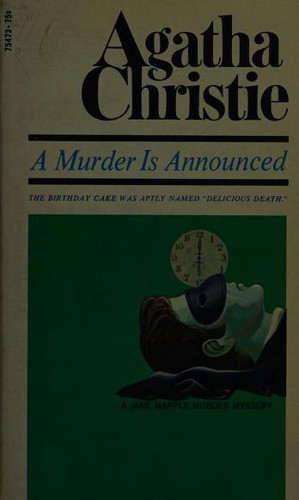
Alternative text for cover: Cover of The Moving FingerA Murder Is Announced (1950, 256 pages), the fourth novel, is the other of the two Marple books Christie considered among her finest work in either series, and -- alongside The Body in the Library -- one of the most commonly recommended starting points for new readers. It followed The Moving Finger.
Alternative text for cover: Cover of A Murder Is AnnouncedThey Do It with Mirrors (1952, 207 pages), the fifth novel, continues the series' sharp social observation of village and class hypocrisy that runs underneath its fair-play plotting. It followed A Murder Is Announced.
Alternative text for cover: Cover of They Do It with MirrorsA Pocket Full of Rye (1953, 203 pages), the sixth novel, keeps to Christie's rigorous fair-play plotting while Marple solves the case through the same village-honed insight into human folly that defines the series. It followed They Do It with Mirrors.
Alternative text for cover: Cover of A Pocket Full of Rye4.50 from Paddington (1957, 253 pages), the seventh novel, continues the series a quarter-century after The Murder at the Vicarage first introduced Marple, still working cases by comparing them to a lifetime of St Mary Mead gossip. It followed A Pocket Full of Rye.
Alternative text for cover: Cover of 4.50 from PaddingtonThe Mirror Crack'd from Side to Side (1962, 240 pages), the eighth novel, keeps Marple in her usual English-village territory, solving a case by pattern-matching it against decades of small-town human behavior. It followed 4.50 from Paddington.
Alternative text for cover: Cover of The Mirror Crack'd from Side to SideA Caribbean Mystery (1964, 224 pages), the ninth novel, is one of the occasional entries that move Marple out of St Mary Mead entirely, this time to a Caribbean resort -- a rare change of scenery that still relies on her village-honed instinct for reading people. It followed The Mirror Crack'd from Side to Side.
Alternative text for cover: Cover of A Caribbean MysteryAt Bertram's Hotel (1965, 248 pages), the tenth novel, sends Marple to a grand London hotel rather than her usual village setting, following A Caribbean Mystery's own departure from St Mary Mead the year before.
Alternative text for cover: Cover of At Bertram's HotelNemesis (1971, 230 pages), the eleventh novel, returns Marple to more familiar territory after the away-from-village settings of A Caribbean Mystery and At Bertram's Hotel, continuing the series' long-running interest in the folly hidden behind respectable appearances.
Alternative text for cover: Cover of NemesisSleeping Murder (1976, 236 pages) was actually written decades earlier, in the early 1940s, and deliberately held back for posthumous publication as Marple's intended final case -- the same trick Christie played with Poirot's send-off, Curtain. It's dated last in publication order and is best read that way, as a farewell rather than a random entry.
Alternative text for cover: Cover of Sleeping MurderMiss Marple's Final Cases and Two Other Stories (1979, 160 pages) is the series' second short-story collection, published posthumously three years after Sleeping Murder closed out the novels. It gathers a handful of shorter cases that didn't fit into The Thirteen Problems decades earlier.
Alternative text for cover: Cover of Miss Marple's Final Cases and Two Other StoriesJane Marple is an elderly, unmarried amateur detective living in the small English village of St Mary Mead, and Agatha Christie's quiet rebuttal to the idea that a detective needs to be dashing, professional, or even taken seriously. Marple solves murders by pattern-matching them against a lifetime of village gossip and human folly — she has, she insists, seen every possible motive for murder already play out over a church fete or a dispute about the vicar's roses. Christie wrote twelve Marple novels between 1930 and 1976, moving her out of St Mary Mead only occasionally (a Caribbean resort, a grand London hotel, a country house full of visiting relatives), and the series is prized for its sharp social observation as much as its plotting: village hypocrisy, class anxiety, and the way everyone underestimates a sweet old lady with knitting in her lap.
The appeal is cosier and more character-driven than Poirot's puzzle-box precision, though the fair-play plotting is every bit as rigorous — Christie considered A Murder Is Announced and The Moving Finger among her finest work in either series. This is the series for readers who want the classic English village mystery done by its best practitioner: gossip as detective method, a detective nobody suspects of being dangerous, and a body in the library to kick things off.
Agatha Christie wrote 12 Miss Marple novels between 1930 and 1976, plus two short-story collections, The Thirteen Problems (1932) and Miss Marple's Final Cases (1979).
Publication order, starting with The Murder at the Vicarage, is the standard approach, and the novels stand alone well. If you want a punchier first book, The Body in the Library or A Murder Is Announced are popular alternative starting points.
It's the last by design. Christie wrote it decades before its 1976 publication and intended it as Marple's final case, published after Christie's own death — read it last, not first.
No. Each novel is a complete, self-contained mystery. Reading order mostly affects how much you notice Marple's reputation growing across the village and among Scotland Yard contacts.
No — they're separate detectives in the same fictional England and never meet on the page. You don't need to read one series to follow the other.
Reading order last verified .