
Conan: The Robert Jordan Novels
sword and sorcery
Series · epic fantasy
The Belgariad series by David Eddings has 5 known books (5 published) and is best read in publication order, starting with Pawn of Prophecy (1982).
Start here: Pawn of Prophecy (1982) — then read straight through in publication order.
The date order of published books and any announced future entries — the default way to read the series.
David Eddings opened The Belgariad in 1982 with Pawn of Prophecy , a 258-page first novel -- the shortest book in the series. It introduces Garion, a farm boy on Faldor's farm who has no idea he's the last in an ancient line of sorcerer-kings, told entirely from his confused point of view until the true nature of the quest is revealed partway through.
Alternative text for cover: Cover of Pawn of ProphecyQueen of Sorcery , also published in 1982, is the second book at 332 pages, more than 70 pages longer than the series opener released the same year. Garion's quest with his aunt Pol and grandfather-figure Belgarath continues across the squabbling kingdoms of the continent, part of the single continuous story the five Belgariad books tell together.
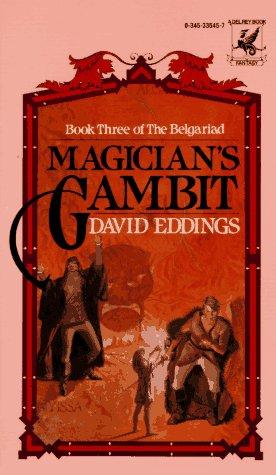
Alternative text for cover: Cover of Queen of SorceryMagician's Gambit followed in 1983 at 320 pages, close in length to Queen of Sorcery before it. The unlikely party -- a horse thief, a Drasnian spymaster princess, a Cherek warrior prince, an Algar horse lord -- presses on toward the stolen Orb of Aldur as the five-thousand-year-old prophecy at the story's center keeps unfolding.
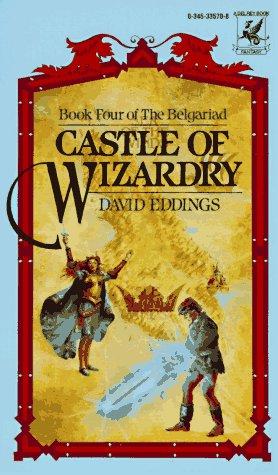
Alternative text for cover: Cover of Magician's GambitCastle of Wizardry , the fourth novel, came out in 1984 at 384 pages, the longest book in the series. Garion's growth from bewildered farmhand toward accepting an identity he never wanted reaches a turning point here, ahead of the concluding volume, Enchanters' End Game , released the same year.
Alternative text for cover: Cover of Castle of WizardryEnchanters' End Game closes The Belgariad, also published in 1984, matching Castle of Wizardry 's 384 pages exactly -- Eddings released the final two books of the series in the same year.
Alternative text for cover: Cover of Enchanters' End GameThe Belgariad opens with Garion, a farm boy on Faldor's farm who has no idea he's the last in an ancient line of sorcerer-kings, swept into a quest alongside his aunt Pol and grandfather-figure Belgarath when a stolen jewel of world-shaping power, the Orb of Aldur, is taken north by a Grolim priest. What follows across five books is a five-thousand-year-old prophecy working itself out through an unlikely party -- a horse thief, a Drasnian spymaster princess, a Cherek warrior prince, an Algar horse lord -- crossing a continent of squabbling kingdoms each modeled loosely on a real-world culture (the dour Alorns, the merchant Tolnedrans, the honor-bound Arends) to return the Orb and confront the one god who broke ranks with his six brothers. Eddings, working from a self-consciously acknowledged quest-fantasy formula, leans into that familiarity with constant, knowing humor -- Belgarath and Polgara bicker like the seven-thousand-year-old family members they are, and Garion's naivety is played for laughs even as the stakes escalate. The series is less interested in subverting Tolkien's quest template than in perfecting a warm, character-driven version of it: the pleasure is in the banter, the slowly revealed depth of Belgarath and Polgara's history, and Garion's growth from bewildered farmhand into someone who has to accept an identity he never wanted. It's frequently cited as a gateway series for young fantasy readers precisely because of that lightness of tone, even as the plotting and worldbuilding underneath are genuinely intricate.
Publication order -- Pawn of Prophecy, Queen of Sorcery, Magician's Gambit, Castle of Wizardry, Enchanters' End Game. It's one continuous story across five books, not five standalone novels.
Yes. The Malloreon is a direct sequel that assumes full knowledge of how the Belgariad ends and follows the same core characters years later.
Yes -- those two books are prequels covering Belgarath and Polgara's backstory, written to be read after both the Belgariad and the Malloreon since they spoil events from later in the story.
Five: Pawn of Prophecy (1982), Queen of Sorcery (1982), Magician's Gambit (1983), Castle of Wizardry (1984), and Enchanters' End Game (1984).
It's often recommended as a starter epic fantasy series for teens -- the content is relatively mild compared to later Eddings work, and Garion's coming-of-age arc is central to the story.
Reading order last verified .