




The Hitchhiker's Guide to the Galaxy
science fiction
Series · science fiction
The Apprentice Adept series by Piers Anthony has 7 known books (7 published) and is best read in publication order, starting with Split Infinity (1980).
Start here: Split Infinity (1980) — then read straight through in publication order.
The date order of published books and any announced future entries — the default way to read the series.
Split Infinity launched Piers Anthony's Apprentice/Adept series in 1980 at 368 pages, introducing Stile's double life across two versions of the same world -- Proton, a rigidly stratified science-fiction planet of rigged games, and Phaze, its magical parallel dimension where Stile has a sorcerer counterpart.
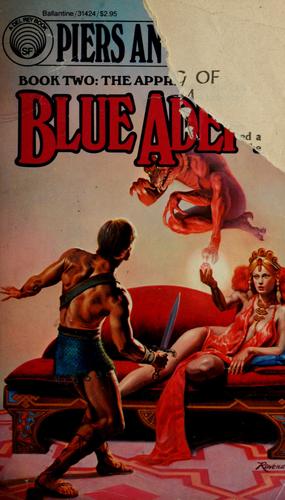
Alternative text for cover: Cover of Split InfinityBlue Adept followed a year later, in 1981, slightly shorter at 327 pages, continuing Stile's parallel rise through Proton's sanctioned Games and Phaze's magical political intrigue as the second book of the original trilogy.
Alternative text for cover: Cover of Blue AdeptJuxtaposition completed the original trilogy in 1982, running 358 pages, bringing Stile's interwoven story across Proton and Phaze to its first conclusion before Anthony returned to the series five years later.
Alternative text for cover: Cover of JuxtapositionFive years passed before Out of Phaze continued the series in 1987, the shortest book yet at 288 pages. It opens the concluding four-book arc that shifts focus toward the next generation navigating the same Proton/Phaze divide.
Alternative text for cover: Cover of Out of PhazeRobot Adept came the following year, 1988, at 341 pages, continuing the second arc's deepened political stakes across both Proton's cybernetic games and Phaze's sorcery.
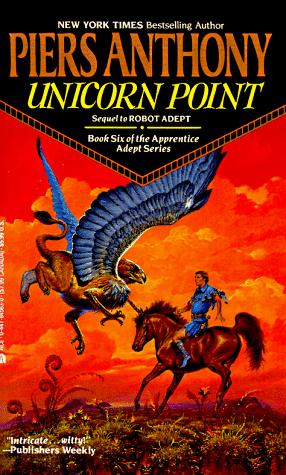
Alternative text for cover: Cover of Robot AdeptUnicorn Point followed in 1989, a year after Robot Adept, at 337 pages, advancing the closing tetralogy's dual-world story toward its resolution.
Alternative text for cover: Cover of Unicorn PointPhaze Doubt closed the series in 1990, the year after Unicorn Point, at 352 pages -- just shy of Split Infinity's opening length -- bringing the seven-book, genre-blending chronicle of Proton and Phaze to its end.
Alternative text for cover: Cover of Phaze DoubtStile lives a double life across two versions of the same world: Proton, a rigidly stratified science-fiction planet where citizens compete in dangerous sanctioned games (the Game) for the vanishingly rare chance to become one of its ruling elite, and Phaze, a parallel fantasy dimension of magic, unicorns, and political intrigue where Stile's own counterpart is a powerful Adept sorcerer. Anthony structures the series around the two settings' constant, deliberate contrast — Proton's plots hinge on genetic engineering, cybernetics, and rigged competitions, while Phaze's hinge on magical duels and courtly conspiracy — while a single continuous story about Stile's rise, romance, and political maneuvering runs through both worlds simultaneously, chapter by chapter alternating between them.
The series was originally conceived and published as two distinct arcs: an initial trilogy (1980-1982) establishing Stile's discovery of Phaze and his rise in both worlds, followed five years later by a concluding tetralogy (1987-1990) that shifts focus toward the next generation and deepens the political stakes on both sides of the Proton/Phaze divide. Read together, the seven novels form one of Anthony's most structurally ambitious works: a genre-blending duology-of-a-world that treats science fiction and fantasy not as separate genres but as two consistent, interlocking rule systems governing the same underlying story.
Seven novels in two arcs: an original trilogy (Split Infinity through Juxtaposition, 1980-1982) and a concluding tetralogy (Out of Phaze through Phaze Doubt, 1987-1990).
Publication order, starting with Split Infinity. Read the original trilogy first, then the tetralogy - the later four books build directly on the first three.
One character, Stile, lives a double life split between Proton, a science-fiction world of rigged games and rigid class structure, and Phaze, its parallel fantasy dimension of magic and sorcery, with a single continuous story running through both.
Yes. All seven novels were published between 1980 and 1990, with the final four appearing five years after the original trilogy concluded, and Piers Anthony has not returned to the series since.
To follow the full story, yes - the tetralogy directly continues the trilogy's plot and characters, though the original trilogy alone does offer a complete arc if you want to stop there.
science fiction

science fantasy

science fiction

science fiction

science fiction

science fiction

science fiction

science fiction
Reading order last verified .